A structured, phase-gated framework for postural correction — designed to work with the nervous system, not just the spine. It's also how a group gets consistency: every practitioner delivers the same framework, the same sequence, and the same report language — and every patient can see exactly where they are in the journey.
Chronic postural distortion alters proprioceptive input, drives compensatory muscle patterning, and eventually becomes the brain’s “new normal.” The body genuinely believes the distorted position is correct. That is why random exercise prescriptions rarely produce lasting change. The 4R Protocol addresses posture in the sequence the nervous system requires — each layer preparing the system for the next.
Clear the structural restrictions that prevent correction. Passive tissue work that decompresses joints, lengthens restricted soft tissue, and creates the biomechanical space needed for active change. You cannot build a straight wall on a twisted foundation.
Rebuild active neuromuscular control. Postural collapse is frequently a deep stabiliser problem — larger surface muscles overactivate while the deeper supporting muscles become inhibited. R2 re-activates these muscles with low-load, high-repetition movements that re-establish their holding function. Rehabilitation, not gym training.
Update the postural blueprint. The brain maintains posture through a constant stream of feedback from joints, muscles, and balance systems. R3 introduces controlled instability and joint position sense training so the nervous system learns to find and hold the corrected posture without falling back on old compensation patterns.
Stabilise the whole system. Chronic postural distortion often compresses the chest and drives breathing upward into the neck and shoulders. R4 introduces full diaphragmatic breathing in the corrected position — supporting a calmer nervous system and making every other layer more durable.
Posture 4 Health prescribes from each layer automatically as a client progresses, with exercises, reports and reminders matched to where they’re at.
You cannot build a straight wall on a twisted foundation. Before asking muscles to activate differently, mechanical restrictions that prevent movement need to be addressed. R1 may include myofascial release, joint mobility work, and postural traction where indicated. It runs throughout every phase — its role evolves, but restriction management never fully stops.
Postural collapse is often a deep stabiliser problem — the larger surface muscles overactivate while deeper supporting muscles become inhibited and weaker. R2 focuses on re-activating these deep muscles with low-load, high-repetition movements that re-establish their holding function. This is rehabilitation, not gym training.
The brain maintains posture through a constant stream of feedback from joints, muscles, and balance systems. R3 introduces controlled instability and joint position sense training so the nervous system learns to find and hold the corrected posture without relying on old compensation patterns — in clinic and at home.
The breathing system is the layer most often overlooked. Chronic postural distortion can compress the chest and push breathing upward into the neck and shoulders. R4 introduces full diaphragmatic breathing in the corrected posture, supporting a calmer nervous system and making every other layer more effective and more durable.
Introducing proprioceptive challenge before there is enough deep stabiliser support tends to cause clients to fall back on old compensation patterns — reinforcing exactly what the programme is trying to change. The sequence protects the client’s progress.
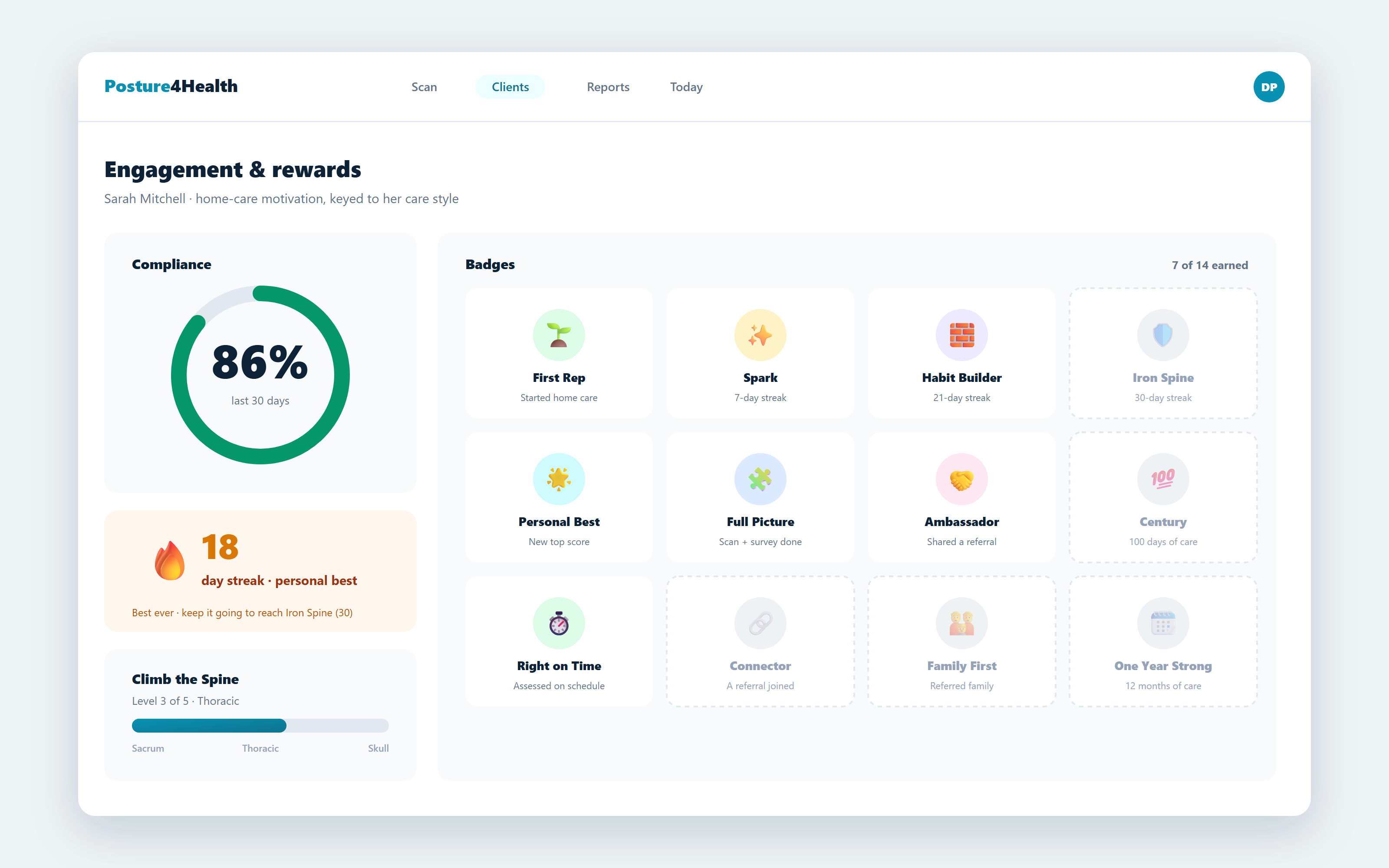
Each layer’s exercises are written in accessible, non-alarmist language, delivered automatically by email, and tracked for compliance — so your team can see who’s on track and who needs a nudge, without extra admin work.
The 4R Protocol is designed to be modular. Not every practice runs a full corrective model — and that is entirely by design. When you set up your account, you choose how many layers to activate based on your clinical focus. You can update this at any time from your practice settings.
If your practice is primarily relief-based, activate Release only. Your clients receive targeted mobility and tissue work to support symptom management alongside your adjustments — without introducing a structured corrective programme they are not ready for.
For practices focused on corrective care without full neurological rehabilitation, R1 and R2 give you the foundation work and active stabiliser retraining that underpin structural change. A solid two-layer approach for practices building towards a corrective model.
Add proprioceptive training and nervous system integration to your corrective protocol. R1 through R3 is the most common configuration for CBP-aligned and neurologically informed practices, driving durable postural change through structural, muscular, and neural re-education.
The complete framework. All four layers active, including diaphragmatic breathing and autonomic regulation. Best suited to practices running a full wellness or vitalistic model where long-term nervous system health is central to the client journey.
Your configuration sets the default for all new clients in your practice. You can still adjust individual clients as needed — your settings simply ensure every new client starts in the right programme for your model of care.
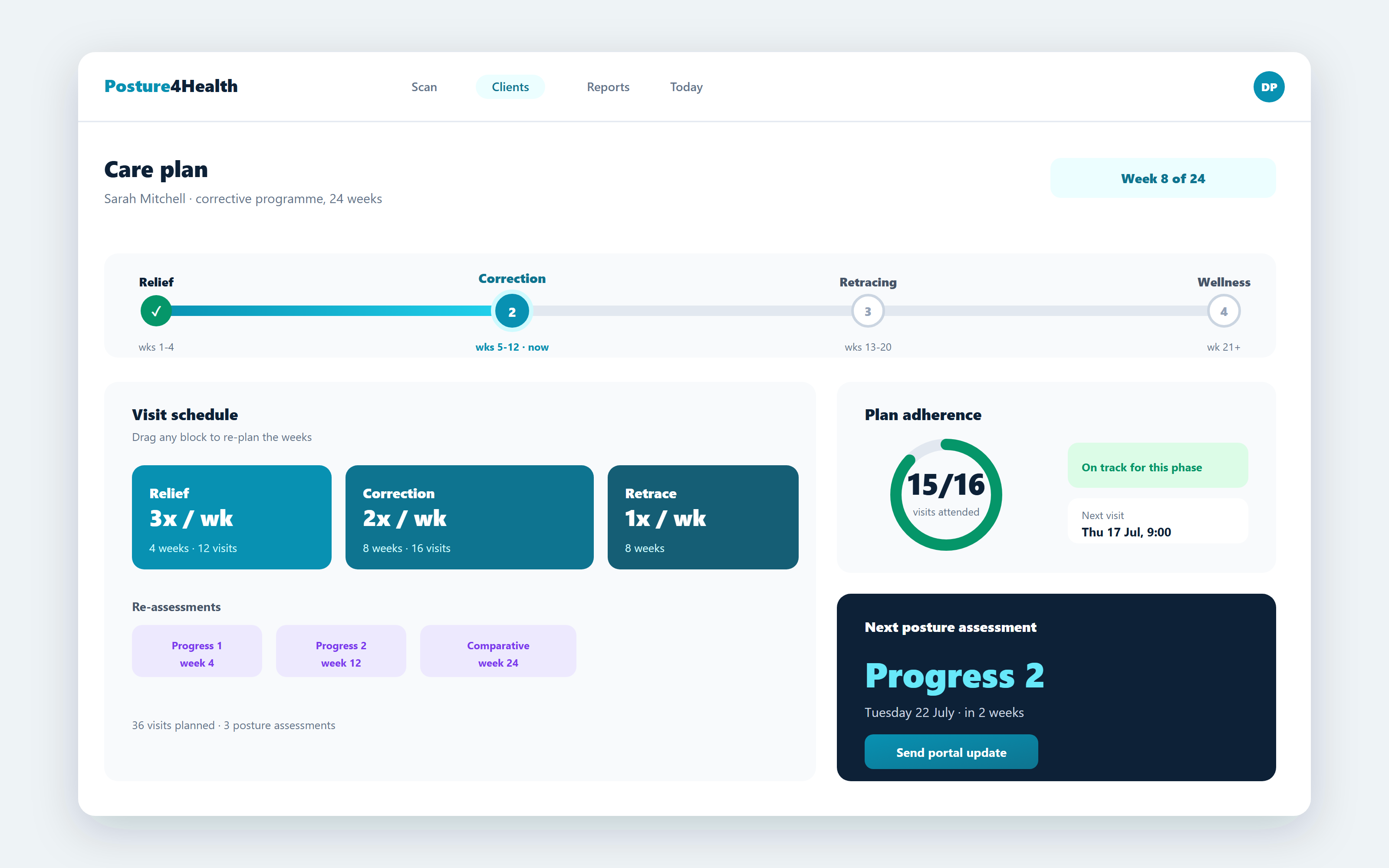
Each phase is unlocked by reassessment, not by calendar. The gating ensures the nervous system has time to consolidate each layer before building on it. Rushing tends to produce regression, not progress.
Release only. Creating biomechanical space before asking anything active of the system.
Release and Restore. Active stabiliser recruitment introduced on newly prepared tissue.
Release, Restore, and Rewire. Proprioceptive challenge introduced once structural support is established.
All four layers active. Breathing and regulation integrated to complete and maintain the system.
Clients showing strong Vitality Score improvement may progress quickly. Complex or long-standing presentations may need more time in a phase. The scan data drives that decision — not the calendar. Posture 4 Health surfaces this automatically at each reassessment.
The Vitality Score (0–100) is a composite of postural measurements from lateral and anterior-posterior views, covering head position, spinal alignment, shoulders, hips, and lower limbs. It is a directionally consistent tracking tool — not a diagnostic label.
The two highest-priority fault regions are addressed together. A higher overall postural load calls for a broad base before targeted correction begins.
The primary fault region takes priority. There is enough systemic stability to respond well to focused correction in one area.
The practitioner selects from the leading candidates. The structure is close to its goal, and clinical judgement guides the final correction.
Both live in the same app. A client can move between them at any time — nothing is lost when they switch.
For clients seeking symptomatic relief or who are not yet ready for a structured programme. The focus is the top-priority exercises from the scan, delivered by email with compliance tracking. No phase progression — just genuinely useful, session-by-session support.
For clients committed to structural change. Includes the full phase progression, home exercise compliance tracking, and regular reassessment. The Vitality Score becomes a motivational tool — visible, measurable progress that gives both practitioner and client a shared sense of accountability.
Scan, score, phase gating, patient portal — a 20-minute walkthrough of the whole loop, configured the way your practice would run it.
Book a Demo